Signed in as:
filler@godaddy.com

DroneWarz (dronewarz.org) is one of the Cyber Defense Center's first hands-on research programs dedicated to exploring the security of emerging technologies such as unmanned aerial systems and robotics through live adversarial simulation, engineering, and community-driven innovation.
Originally launched within the DefCon R00tz program and later expanded into a full-scale hacking village at DEFCON, DroneWarz brought together security researchers, engineers, students, and industry leaders to explore a rapidly emerging problem space: how drones can be hacked, manipulated, defended, and ultimately secured in real-world environments.
From DefCon 23 through DefCon 27, DroneWarz evolved from a youth-focused robotics initiative into one of the most dynamic and widely discussed villages at DEFCON. Participants did not just study drone security, they experienced it in real time, engaging with active systems in controlled environments designed to simulate real-world threats and adversarial conditions.
The program introduced a unique approach to cybersecurity training and research by combining:
The Official Drone & Robotics Hacking Village @ DefCon and other national hacking conferences.
ALL SKIES BELONG TO US!
This page serves as the official page for the DroneWarz program, formerly located at DroneWarz.com, now folded into the Cyber Defense Center.
The purpose of combining this program is threefold:
1. Elevate the DroneWarz Research
DroneWarz explored critical vulnerabilities and emerging threats in UAV and autonomous systems before these threats became widely recognized security concerns.
2. Community Funding and Contribution
The program was built and operated by a dedicated community of volunteers, researchers, and partners who contributed to advancing drone security knowledge.
3. Enable Future Innovation
The concepts, games, and research developed through DroneWarz continue to in operation and inform modern work in:
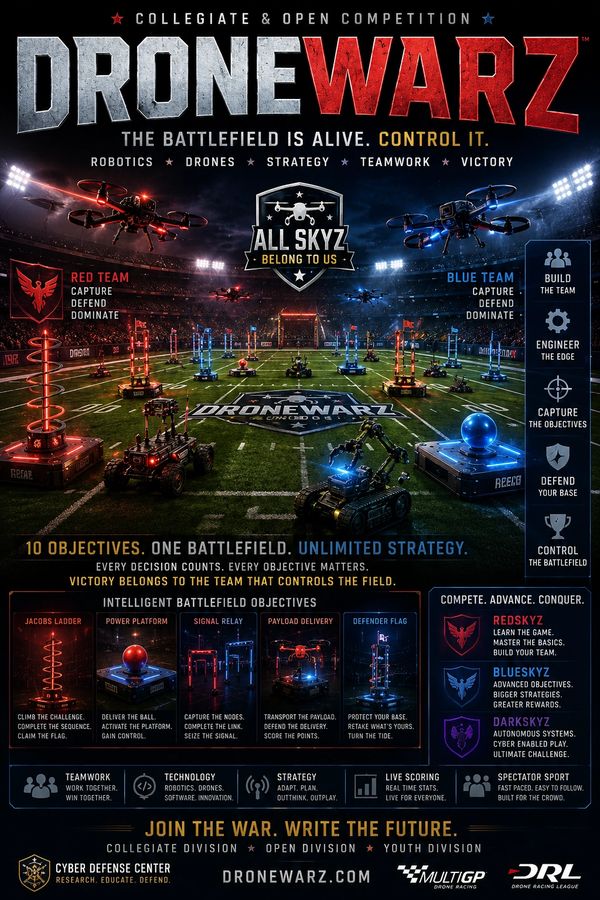
The Battlefield is Alive. Control It. < 5 vs 5 >
DroneWarz™ is a large-scale, team-based cyber-physical competition that transforms an entire football field into an intelligent battlefield where robotics, drones, autonomous systems, and strategy converge.
Developed for collegiate competition and open league play, DroneWarz combines robotics, unmanned aerial systems, embedded electronics, wireless communications, and live battlefield analytics into a spectator-driven sporting experience unlike anything before it.
Two teams compete to capture, defend, and control interactive battlefield objectives distributed across a full-size field. Every objective communicates with a central game engine, continuously tracking ownership, scoring, and battlefield momentum while projecting the action in real time for players and spectators.
This is not a race. It is a battle for the battlefield.
The Battlefield
Each DroneWarz competition is played on a regulation football field configured with ten active Battlefield Objectives selected from a seasonal library of twenty-five unique objective designs.
Each competition includes:
Because objectives are selected from a larger library and repositioned throughout the season, every battlefield is unique. Teams must study the terrain, adapt their tactics, and make strategic decisions in real time. o two DroneWarz competitions are exactly alike.
Built for Collegiate Competition
DroneWarz was conceived as an intercollegiate sport where engineering, computer science, cybersecurity, robotics, aviation, and esports converge.
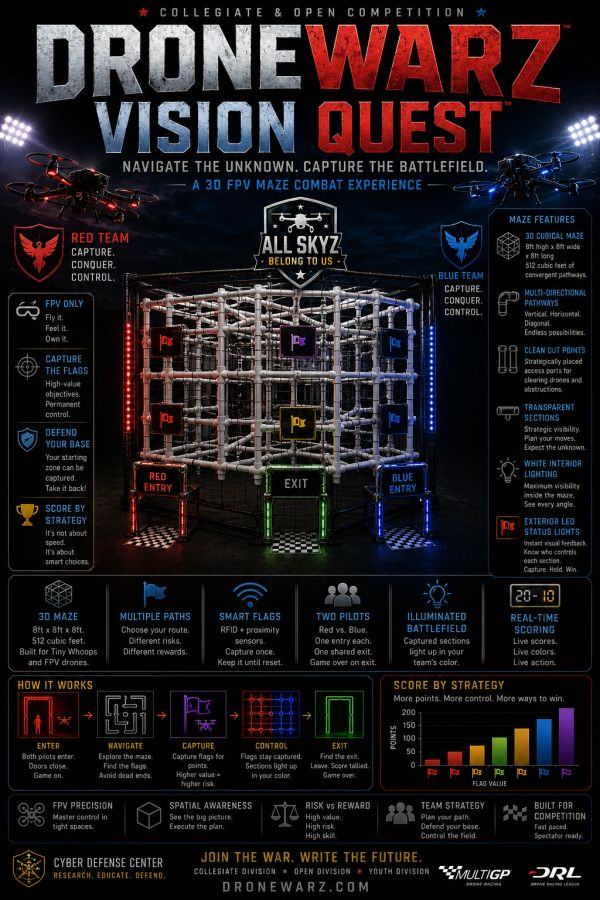
Navigate the Unknown. Capture the Battlefield. < 1 vs 1 >
Vision Quest™ is a first-person-view (FPV) drone competition that transforms drone racing into a game of strategy, exploration, and territorial control.
Developed in collaboration with FatShark, Vision Quest challenges two pilots to navigate an enclosed three-dimensional illuminated maze while competing to capture intelligent battlefield objectives hidden throughout the course.
Unlike traditional drone racing, success is not determined by who finishes first. Victory belongs to the pilot who controls the battlefield.
The Battlefield
Vision Quest is built around a fully enclosed three-dimensional maze constructed from illuminated six-inch PVC structures.
Designed specifically for Tiny Whoop-class aircraft, the maze creates an immersive environment where pilots must rely entirely on their FPV systems to navigate.
The course includes:
Once both pilots enter the maze, the entry portals are closed, committing each competitor to the course. There is only one way out.
A Convergence Maze
Unlike a traditional race course with a prescribed route, Vision Quest is a convergence maze.
Multiple paths branch, merge, and intersect, forcing competitors to make continual strategic decisions.
Some routes provide quick access to lower-value objectives.
Others require significantly greater skill to reach but offer substantially higher rewards. Every decision carries opportunity and risk.



DefCon (Primary Village) | R00tz Asylum
DroneWarz was designed as a live cyber-physical research environment, where participants could engage drones, controllers, and autonomous systems through hands-on challenges, competitive objectives, and collaborative experimentation. DroneWarz participated in several other national venues in addition to Defcon including:

The DroneWarz Village was built around a series of structured challenge arenas, each representing a different aspect of drone and autonomous system security.
Focused on direct drone exploitation. Participants identified vulnerabilities and developed methods to manipulate drones in flight or in operation.
Explored control system and RF vulnerabilities. Participants attempted to intercept, disrupt, or take control of drone communications and ground control systems.

These arenas led to games being built, awards, and new drone concepts presented at Defcon.
An offensive development environment where participants built and deployed payloads using Raspberry Pi and Arduino platforms. These payloads enabled experimentation with signal interception, evasion, and advanced drone capabilities.
A defensive and forensic arena. Participants analyzed captured drones to reconstruct missions, identify payloads, determine flight paths, and attribute activity.
An open innovation lab and makerspace. Participants could build, modify, and test drones, payloads, and hardware concepts in a collaborative environment.
DroneWarz introduced a unique set of drone-centric capture-the-flag objectives designed to simulate adversarial scenarios across offensive, defensive, and analytical domains.
Examples included:
These objectives bridged multiple domains, including RF communications, embedded systems, forensics, and adversarial simulation.

Objectives were also presented by sponsors for research or discovery. These were designed to blend traditional cybersecurity challenges with real-world UAV systems.
Other examples included:
DroneWarz extended beyond traditional challenges into fully interactive, competitive games designed to simulate real-world drone scenarios.
Teams deployed drones in a controlled arena to capture flags, disrupt opponents, and dominate the airspace.
A search-and-locate game where participants identified hidden or active drones using RF, visual, and telemetry analysis.
A frequency-rich environment challenge where participants tracked FPV camera feeds to locate targets.
Participants attempted to bring down a drone in flight using non-kinetic techniques such as signal manipulation and control disruption.
These games created a high-energy, adversarial environment that blended competition with real-world security challenges.
DroneWarz was designed to be both a research platform and a spectator experience, making it one of the most engaging villages at DefCon.
The village created an environment where research, competition, and entertainment converged, drawing significant attention from attendees and media.

At its core, DroneWarz was a forward-looking research initiative focused on understanding and securing drone and autonomous systems.
Key research areas included:
The program also explored advanced concepts such as:
DroneWarz provided a rare opportunity to observe, test, and refine these concepts in live environments, bridging the gap between theoretical research and real-world application.






DroneWarz was sponsored and supported as a forward-looking research initiative to explore emerging risks in:
At the time, drone security was largely unexplored in practical environments. The Cyber Defense Center recognized early that:
Many DroneWarz scenarios and presentations mirrored conditions now seen in modern conflicts, where drones are used for:
The adversarial structure of DroneWarz games allowed participants to experiment with:
These environments demonstrated how small, inexpensive systems could have outsized operational impact, particularly when coordinated or deployed at scale.
While presented as competitive games, these scenarios directly reflected emerging global security concerns.
DroneWarz anticipated a future where:
The games provided early insight into how these threats could manifest and be countered through:
Drones offered a fun and engaging technology platform to explore our primary research mandates. Therefore, the principles explored in DroneWarz intentionally extended well beyond drones.
The same vulnerabilities and control mechanisms apply to:
Key parallels include:
DroneWarz effectively created a microcosm of cyber-physical system security, where lessons learned from UAV interactions could be applied to broader domains.
DroneWarz demonstrated that games can serve as powerful tools for:
What appeared as entertainment on the surface was, in practice, a structured exploration of the future battlespace, where cyber and physical systems converge.