Signed in as:
filler@godaddy.com
The Cyber Defense Center delivers specialized cybersecurity services for organizations facing high-consequence risks, wartime cyber threats, operational disruption, fraud, and the accelerating impact of artificial intelligence. Our service model is built upon two complementary pillars:
ASCEND | DEFEND
Together, ASCEND and DEFEND provide a complete lifecycle approach to cyber defense, helping organizations prepare, protect, respond, recover, and continuously improve.

Build Capability. Strengthen Readiness. Create Advantage.
ASCEND helps organizations prepare for the next era of cyber threats through assessments, testing, training, exercises, compliance support, and strategic advisory services. Our programs identify weaknesses, validate defenses, develop workforce capabilities, and improve organizational resilience before a crisis occurs.
ASCEND Services allow you and your company to:
Review our core ASCEND services here:
Protect Operations. Respond with Confidence. Maintain Resilience.
DEFEND delivers operational cyber defense services designed to help organizations detect threats, respond to incidents, strengthen defenses, and maintain business continuity. From ransomware response and threat monitoring to security engineering and managed services, DEFEND provides practical protection where failure carries real consequences.
Core Capabilities

OTSEC™ SECTOR SPECIFIC (Critical Infrastructure)
SAMURAI PATH
OPSEC

Our methods are informed by ongoing research programs, emerging threat analysis, and operational testing. Learn more about our Research charter here.
Our consultants help develop the same training and certification programs used to prepare future defenders. Learn more about our innovative Training programs here.
We incorporate cyber conflict doctrine, force posture analysis, and readiness principles rarely found in traditional consulting engagements. Learn more about our Wartime Doctrine here.
As a charitable organization, we focus on strengthening collective cyber defense rather than maximizing billable hours. Learn more about our company mission focus here.
Unlike traditional consulting engagements that often obscure costs behind blended rates, utilization targets, and complex billing structures, the CYBER DEFENSE CENTER utilizes a transparent cost-plus engagement model.
Clients are provided visibility into engagement costs before a Statement of Work is executed, allowing organizations to understand how resources are allocated and how project costs are derived. This approach helps organizations maximize value, make informed decisions, and ensure that resources are focused on outcomes rather than billable hours.
Transparency builds trust. Trust enables partnership. Partnership strengthens collective defense. Learn more about our Trust through Transparency tenet here.
The CYBER DEFENSE CENTER believes cybersecurity is a shared responsibility. Through our ACSEND | DEFEND programs, we help align experienced professionals, emerging defenders, community organizations, and critical infrastructure operators to strengthen local and regional cyber resilience. Learn more about our mutual aid and collective defense initiatives here.
Cybersecurity is not a product nor it is not a compliance exercise. And it is most certainly not a one-time project.
It is the continuous development of capabilities, the validation of readiness, and the protection of what matters most.
Whether supporting a utility, manufacturer, healthcare provider, municipality, or critical infrastructure operator, our mission remains the same:
Build Capability. Strengthen Readiness. Defend What Matters.
The Cyber Defense Center has developed innovative methodologies and proprietary models through years of independent research and operational experience. These methods were created to address a simple reality: despite billions of dollars invested annually in cybersecurity, sophisticated adversaries continue to outpace defense.
The reason is foundational. Effective cyber defense is not built solely on technology, compliance, or governance. It is built on mindset, readiness, force posture, intelligence, architecture, adaptability, and continuous training. These elements determine an organization's ability to anticipate, withstand, and respond to modern threats.
Traditional cybersecurity programs frequently emphasize tools, regulatory compliance, and framework implementation. While these remain important components of a mature security program, they do not, by themselves, prevent sophisticated attacks. Our research focuses on strengthening the underlying capabilities that enable organizations to defend, adapt, and prevail against determined adversaries.
Our consulting methodologies integrate cyber defense doctrine, capability development, research, and operational readiness to help organizations build resilient security programs designed for today's threat environment—not yesterday's compliance requirements.
BETTER INTELLIGENCE. BETTER DECISIONS.
Every Cyber Defense Center engagement is informed by ongoing independent research. Our researchers continuously analyze vulnerabilities, data breaches, adversary behavior, industry trends, regulatory developments, artificial intelligence, and wartime cyber operations. This research produces the reference architectures, maturity models, forecasting methodologies, operational doctrine, and decision models that guide every consulting engagement.
Over the past decade, our research platform has evolved beyond individual methods and models into an integrated framework for measuring, improving, and validating cyber defense capability. Every assessment, consulting engagement, and advisory service leverages this research to provide practical, evidence based recommendations that strengthen organizational resilience.
Our professional services are enabled by innovations including:
These capabilities allow us to translate research into practical outcomes, helping organizations visualize their security posture, prioritize investments, validate defensive capabilities, and prepare for an evolving threat landscape.
Explore our Research Programs to learn more about these and other methodologies, technologies, publications, and initiatives that power the Cyber Defense Center.
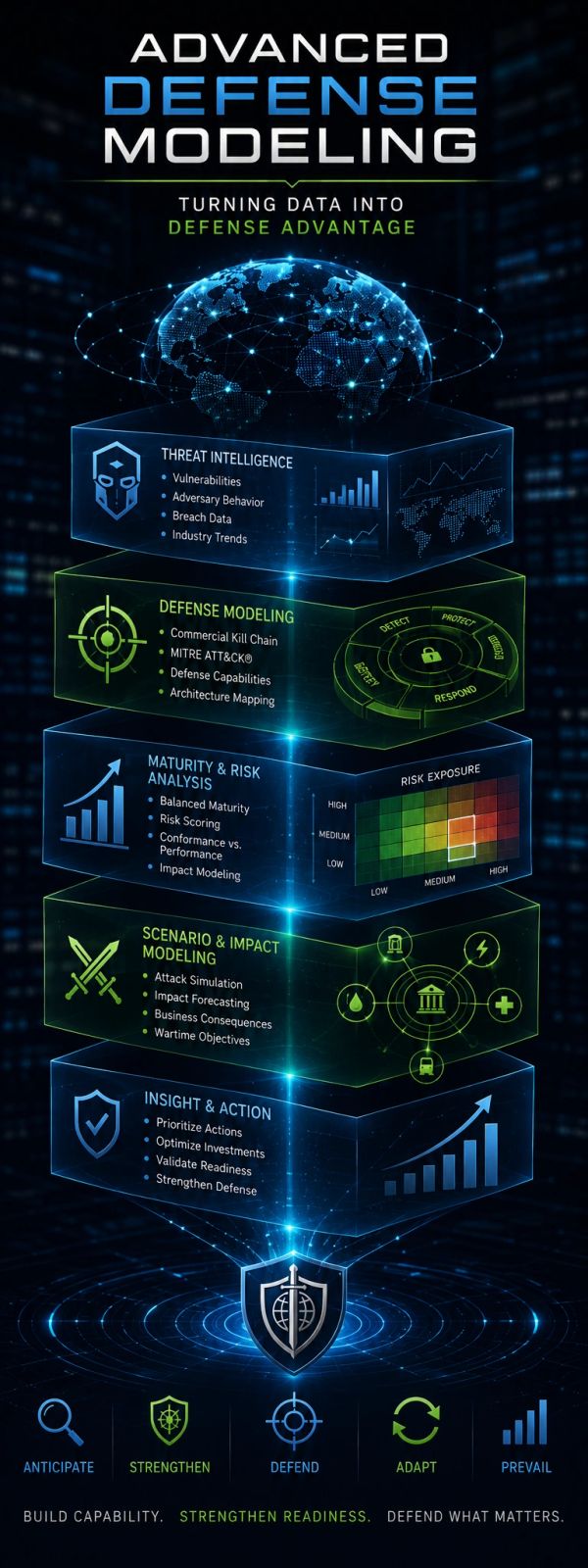
Our defense modeling begins with a simple question: what would it take to defend effectively?
The Cyber Defense Center uses a proprietary defense intelligence methodology to evaluate an organization’s cyber defense capabilities in a comprehensive, operationally relevant manner. Rather than beginning with a checklist or framework, we start with a master model of what modern defense can include, informed by emerging threats, member practices, technology trends, research, and operational lessons learned.
We then assess the organization across seven dimensions:
This model helps organizations move beyond tool ownership and compliance alignment toward a clearer understanding of actual defensive capability, operational readiness, and measurable effectiveness.
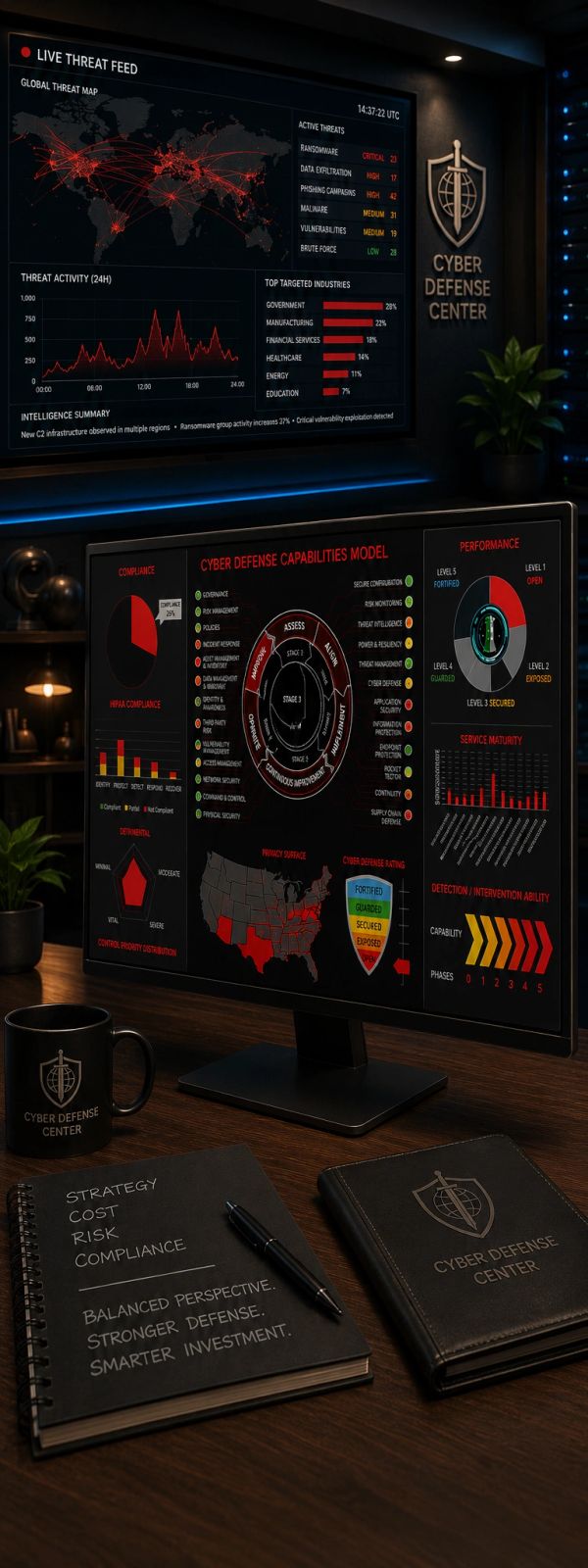
Our Defense Diagnostic assessment extends beyond technical analysis by balancing cyber defense against the realities of your business. Every recommendation is evaluated through four strategic perspectives:
This balanced analysis produces six integrated perspectives that define your organization's overall cyber defense posture. The result is a clear visualization of your security program using the Cyber Defense Center Reference Architecture and our balanced defense maturity models.
Unlike traditional assessments that often recommend purchasing additional technology, our methodology begins by maximizing the value of the capabilities you already own. Through security portfolio rationalization, organizations frequently discover overlapping products, underutilized licensing, deployment gaps, and capabilities that can be strengthened without additional investment.
The expected outcome is simple: do more with less. Organizations gain a more focused, measurable, and defensible security program while reducing unnecessary technology costs and directing investments toward capabilities that measurably improve cyber defense.
Perhaps most importantly, our methodology provides executives with the context and perspective needed to communicate cyber risk as a business issue rather than a technical problem. Whether the outcome is cost reduction, targeted investment, or strategic transformation, leaders are equipped to make informed decisions supported by a comprehensive understanding of their cyber defense posture.
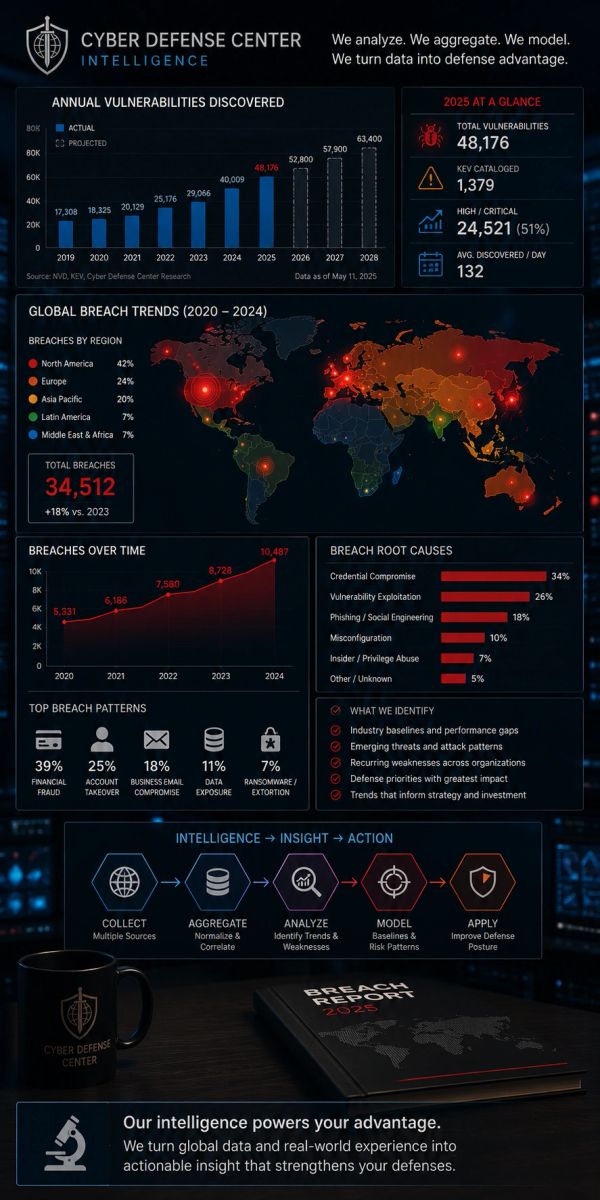
The CYBER DEFENSE CENTER portfolio extends beyond individual assessments and services by continuously analyzing the cybersecurity landscape across industries. Our research includes in depth analysis of major data breaches, cyber threats, software vulnerabilities, privacy developments, legal and regulatory changes, technology trends, and evolving defense priorities.
Our intelligence is derived from multiple sources, including public reporting, industry research, threat intelligence, vulnerability disclosures, legal proceedings, academic research, and insights gained through active and historical consulting engagements. This information is continuously aggregated, normalized, and analyzed to establish industry baselines and identify emerging patterns.
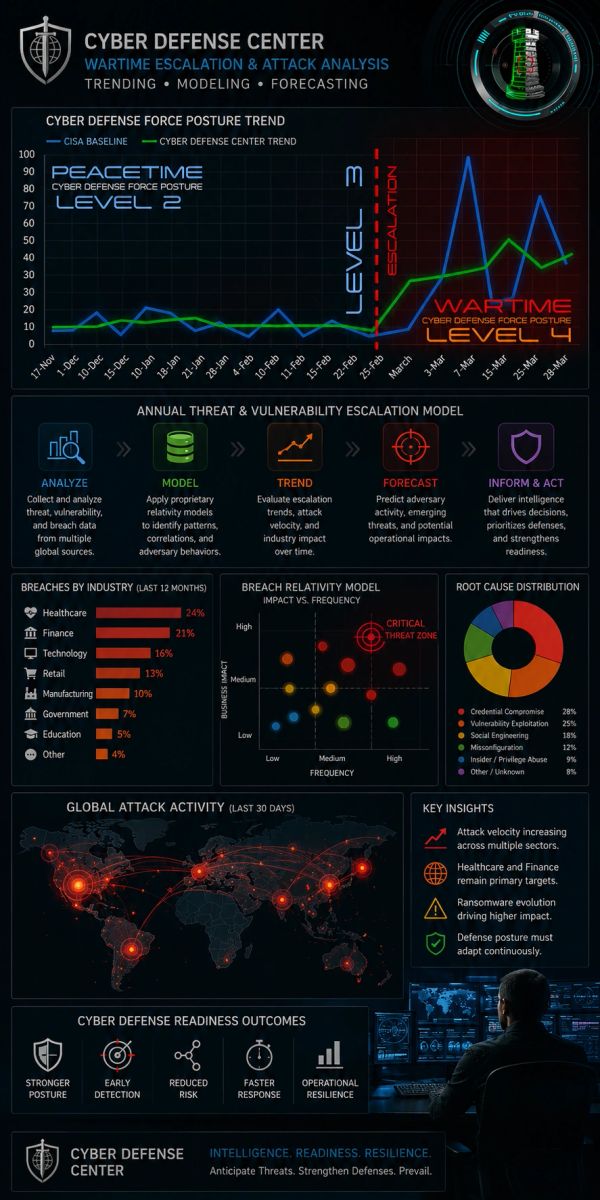
Rather than viewing incidents in isolation, we use this intelligence to model how industries perform over time, identify recurring defense weaknesses, measure capability gaps, and understand how adversaries adapt their tactics. These findings continuously refine our reference architectures, defense maturity models, and consulting methodologies.
The result is intelligence that helps organizations understand not only where they stand today, but how they compare to their peers, how the threat landscape is evolving, and which defense capabilities will have the greatest impact tomorrow.
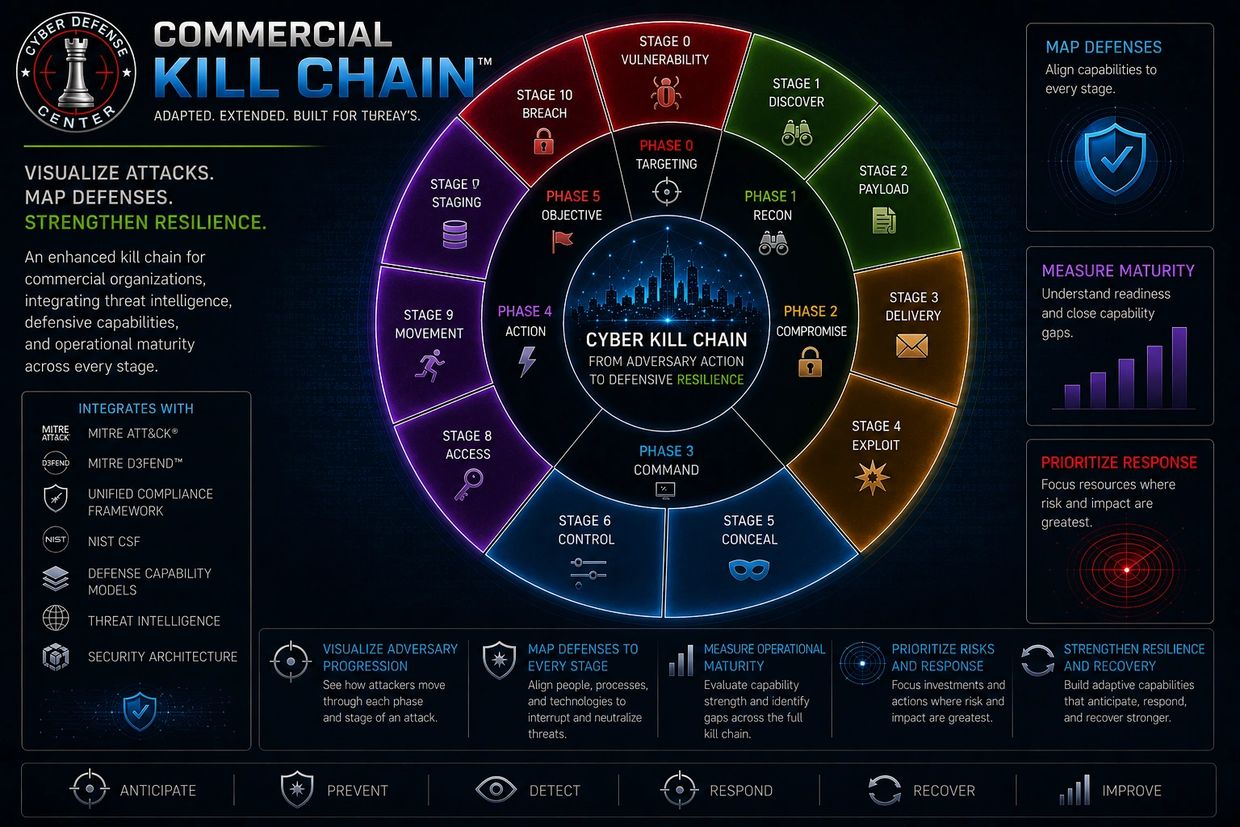
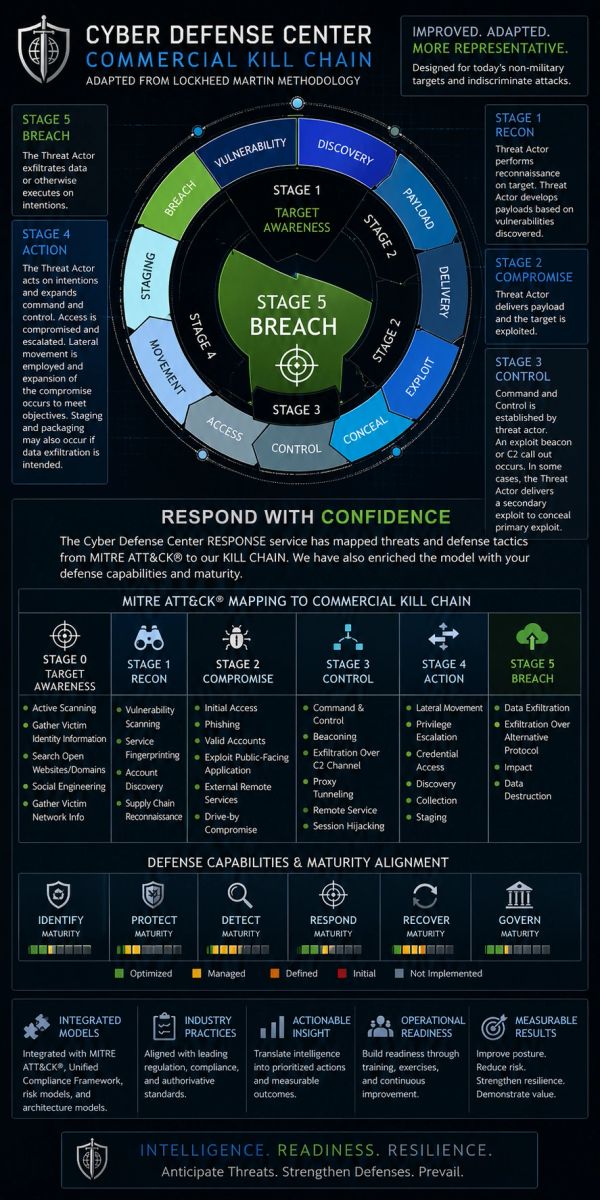
Traditional cyber kill chain models were developed for military operations and highly targeted attacks. The Cyber Defense Center adapted and extended this methodology for commercial organizations by incorporating attack stages commonly observed in enterprise ransomware, opportunistic attacks, fraud campaigns, and secondary exploitation.
Our Commercial Kill Chain integrates with:
• MITRE ATT&CK
• MITRE D3FEND
• Unified Compliance Framework
• NIST CSF
• Defense Capability Models
• Threat Intelligence
• Security Architecture
The model enables organizations to visualize how adversaries progress through an attack while mapping defensive capabilities, operational maturity, and response priorities to every stage.
To help organizations visualize how adversaries progress through an attack and align people, processes, and technologies to interrupt, respond, and recover.
Enabled Outcomes include:
ADAPTED. EXTENDED. BUILT FOR TODAY'S THREATS