Signed in as:
filler@godaddy.com

The future is not faster scanning.
The future is predictive defense.
It is built on software supply chain intelligence, secure by default architectures, contextual risk modeling, continuous hardening, and layered defensive countermeasures that enable organizations to outpace machine speed adversaries.
This is the strategy that emerged from the Cyber Defense Center's research into the Vulnerability Super Cycle and the SILVER Model Breakpoint (show below). It represents a shift from vulnerability management to defense engineering.

Every year, the Cyber Defense Center publishes the Annual Vulgarabilities Report, an independent research initiative that examines global vulnerability trends, emerging threats, and the future of cyber defense. For nearly fifteen consecutive years, our research has accurately forecasted vulnerability growth up to three years and three months beyond each October 1 publication, establishing the SILVER Model as one of the industry's most consistent demand forecasting models.
Over the past eight years, however, our research has identified a phenomenon we call the Vulnerability Super Cycle. Vulnerabilities are no longer increasing through steady, predictable growth. Advances in automation, offensive tooling, artificial intelligence, and software complexity have accelerated both the volume and weaponization of vulnerabilities at an unprecedented rate. The consequences are visible across the industry, contributing to record-breaking breaches while overwhelming vulnerability management programs, the National Vulnerability Database (NVD), and even the CVE ecosystem itself.
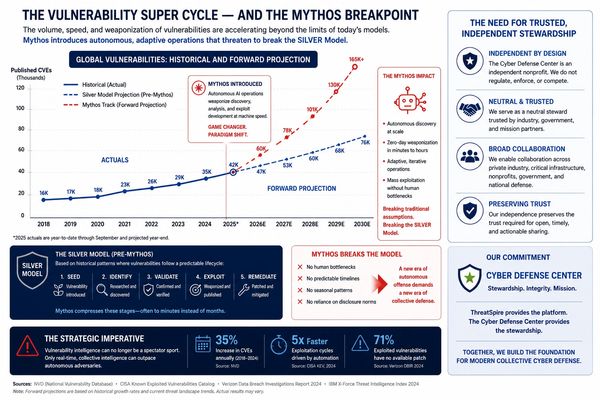
This year's research marks a historic milestone. For the first time in more than fifteen years of publication, the SILVER Model reaches its Breakpoint.
The assumptions that have governed vulnerability science for decades no longer hold. Artificial intelligence is compressing the traditional vulnerability lifecycle from months into hours, eliminating many of the human bottlenecks that once made cyber defense predictable. Discovery, analysis, exploit development, and weaponization are increasingly becoming autonomous processes operating at machine speed.
This research led us to a simple conclusion:
Defending against AI requires more than adding AI to existing security programs. It requires an entirely different defensive strategy. That realization became the foundation for everything we build at the Cyber Defense Center.
Traditional cybersecurity was designed to defend against human-paced adversaries operating within predictable attack cycles. AI changes those assumptions. Future defenders must operate with greater speed, stronger readiness, adaptive architectures, and continuous intelligence rather than relying solely on periodic assessments, compliance frameworks, and manual response.
Our research has fundamentally reshaped how we approach cyber defense. Every service, methodology, training program, certification, and platform developed by the Cyber Defense Center is built around this new reality: collective defense, operational readiness, and adaptive resilience in the age of artificial intelligence.
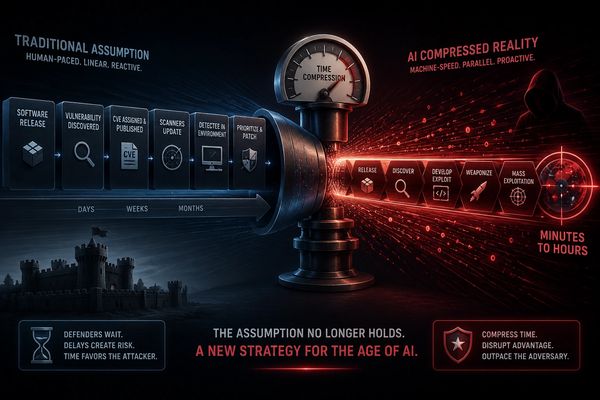
For more than two decades, vulnerability management has been built around a simple assumption: discover vulnerabilities, prioritize them, and patch them before they are exploited.
That assumption no longer holds. Artificial intelligence is compressing the time between software release, vulnerability discovery, exploit development, and mass exploitation. Waiting for vulnerabilities to be assigned CVEs, published in scanning tools, and eventually detected inside an organization creates a delay that increasingly favors the attacker.
The future of cyber defense requires a fundamentally different strategy.
Organizations already know what software they own through Software Bills of Materials (SBOMs). Instead of waiting for vulnerability scanners to discover exposures, organizations should immediately evaluate vendor patches and security updates against their software inventory as they are released. Defensive action should begin at patch publication, not vulnerability detection.
Evolve the Science of Vulnerability Management
Routine patchable vulnerabilities should become an operational maintenance function rather than the centerpiece of vulnerability science.
The discipline should instead focus on the problems that cannot be solved through ordinary patching, including:
These represent the areas where research, intelligence, and coordinated defense create the greatest value.
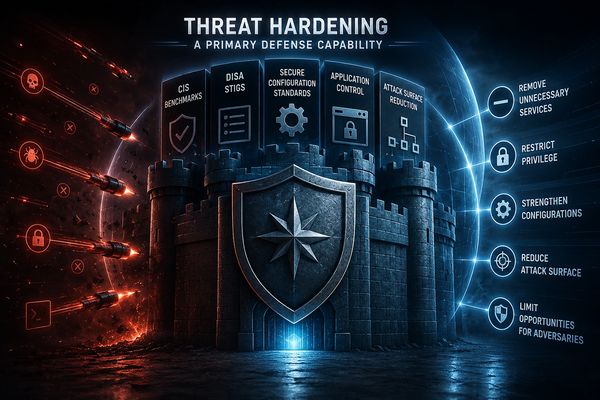
System hardening can no longer be viewed as an adjacent security activity.
Security baselines such as CIS Benchmarks, DISA STIGs, secure configuration standards, application control, and attack surface reduction should become foundational components of AI era defense. Every unnecessary service removed, privilege restricted, and configuration strengthened reduces the attack opportunities available to autonomous adversaries.
Not every vulnerability presents equal operational risk.
Organizations should prioritize defensive investments using contextual defense modeling that evaluates factors such as:
This allows organizations to apply inflationary and deflationary scoring that reflects actual mission risk rather than relying solely on generic severity ratings.
Patching should represent the beginning of defense, not the end.
Organizations should integrate compensating controls into every remediation strategy, including:
The objective is to reduce adversary success regardless of whether every vulnerability can be eliminated.
Risk acceptance has gradually evolved into an administrative mechanism for avoiding difficult remediation efforts.
That model is increasingly incompatible with AI driven attacks.
When vulnerability management evolves beyond patch tracking and focuses on exceptional conditions, formal risk acceptance should become a rare executive decision reserved for truly unavoidable circumstances, not a routine operational workflow.
The future of cyber defense is not simply identifying more vulnerabilities. It is engineering systems that remain resilient even when vulnerabilities exist. This is the foundation of Consequence Informed Systems Engineering and Defense Engineering.
Rather than relying exclusively on periodic scanning and reactive remediation, organizations must build security into products from the beginning while continuously validating their resilience throughout the software lifecycle. Security testing, secure architecture, system hardening, defensive countermeasures, and operational readiness become integrated engineering disciplines rather than isolated security activities.
The objective is to build systems that are inherently more difficult to compromise and more resilient when compromise inevitably occurs rather than simply find weaknesses. That philosophy guides every product assessment, engineering engagement, and research initiative performed by the Cyber Defense Center.
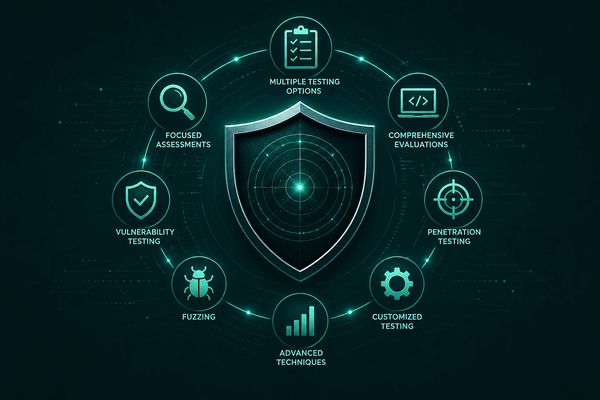
No two products, environments, or development teams are alike. The Cyber Defense Center provides flexible testing services ranging from targeted technical assessments to comprehensive product evaluations designed to meet organizations where they are.
Our testing approaches combine traditional penetration testing, architecture review, secure design analysis, threat modeling, and consequence informed evaluation to identify weaknesses before adversaries do.
When vulnerabilities are discovered, we follow established principles of responsible disclosure and, when appropriate, assist vendors and affected organizations through our Coordinated Vulnerability Disclosure Assistance Program to support timely remediation while protecting customers and the broader community.

Security should not be something organizations validate immediately before release. It should be engineered into products from their earliest design decisions.
Whether preparing a new platform for market, strengthening a mature product, validating security architecture, or investigating emerging threats, the Cyber Defense Center provides independent, technically rigorous analysis that helps organizations design, build, and maintain secure, resilient technologies.
Our objective extends beyond identifying vulnerabilities. We help organizations improve architecture, strengthen defensive posture, reduce operational consequence, and build products capable of withstanding the rapidly evolving threats of the AI era.