Signed in as:
filler@godaddy.com
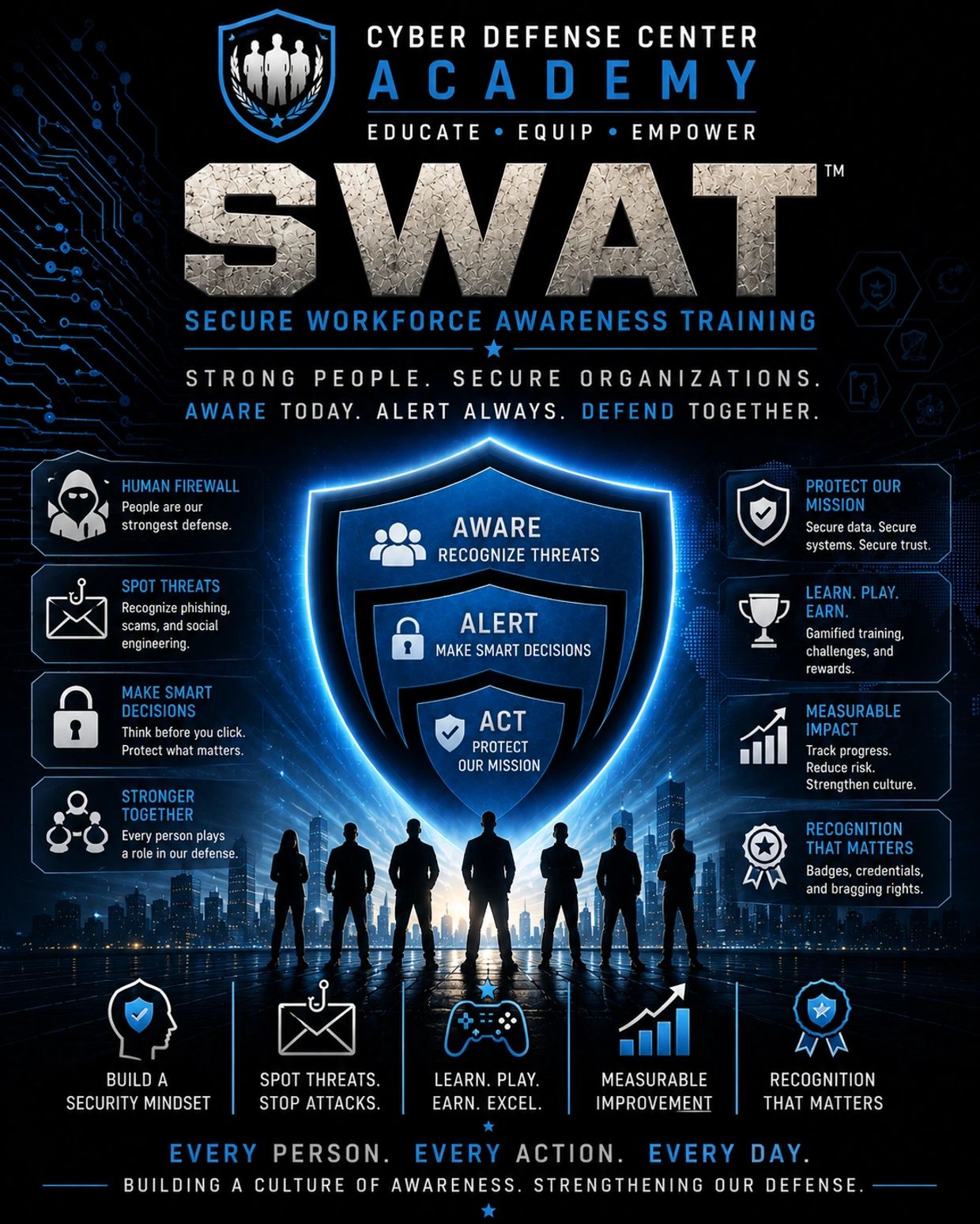
The Cyber Defense Center Academy offers workforce training and certifications designed to develop capable defenders, strengthen security culture, and build measurable cyber defense readiness. Through engaging instruction, gamified learning, realistic exercises, and progressive certifications, the Academy equips professionals with the knowledge, skills, and mindset needed to protect organizations against today's evolving cyber threats. We don't simply train the workforce—we build capability, recognize achievement, and strengthen communities through continuous learning and operational excellence.
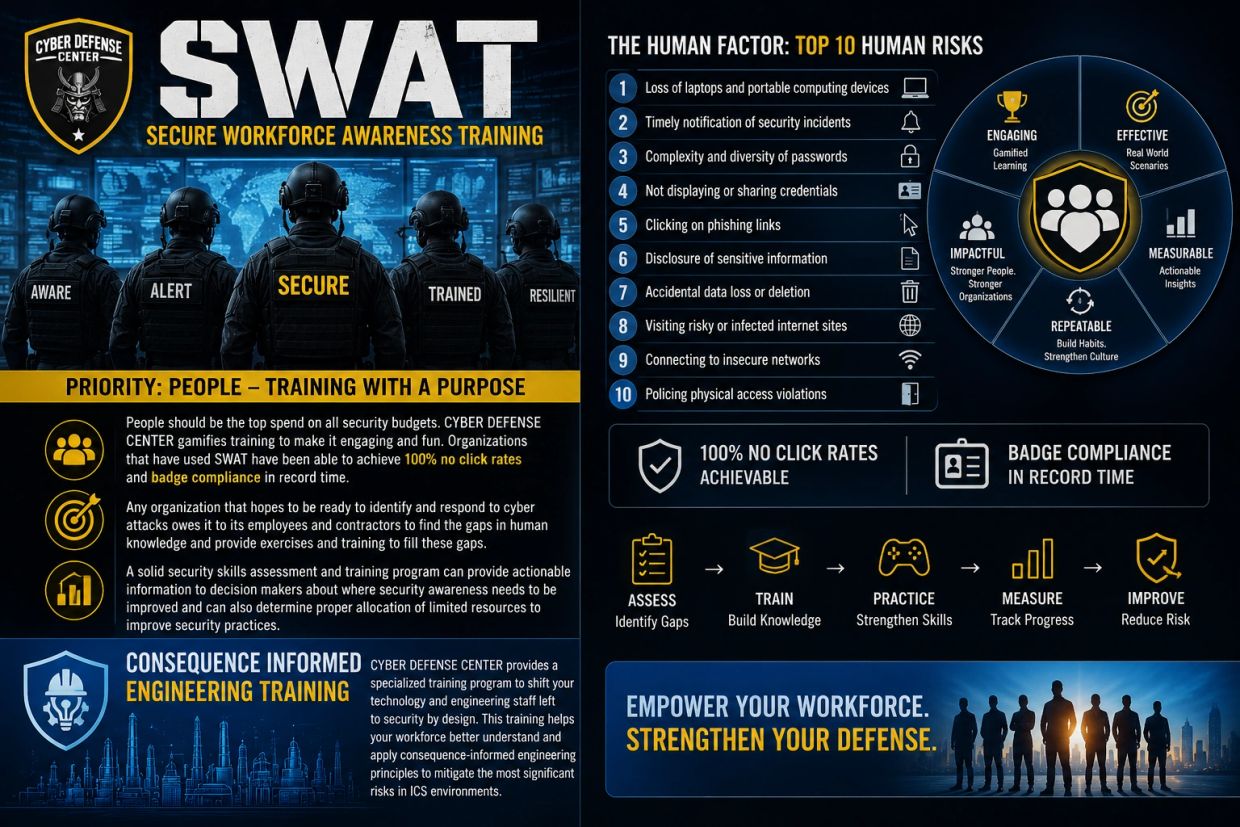
SWAT™ (Secure Workforce Awareness Training) is the world's first workforce awareness certification designed to recognize organizations that demonstrate measurable human cyber defense capability. Rather than certifying course completion, SWAT certifies workforce readiness through continuous measurement, behavioral science, realistic exercises, and validated operational performance.
People remain the most targeted and influential component of every cyber defense strategy. Whether protecting sensitive information, identifying social engineering attacks, reporting suspicious activity, safeguarding operational technology, or supporting business continuity during cyber incidents, organizational resilience depends upon a workforce that is prepared to recognize threats, make informed decisions, and respond with confidence.
Unlike traditional awareness programs that emphasize annual compliance and check the box training, SWAT™ develops measurable human capability. Through engaging challenges, role based learning, simulations, competitions, and progressive certifications, participants continuously strengthen the knowledge, skills, mindset, and behaviors required to reduce organizational risk and improve operational readiness.
SWAT™ research and services include:
As SWAT™ evolves alongside the changing threat landscape, it provides organizations with a comprehensive, capability based approach to developing their most important cyber defense asset: their people. By combining education, practical application, continuous measurement, and meaningful recognition, SWAT™ helps organizations build security cultures where awareness becomes action, capability becomes readiness, and every employee contributes to defending what matters. The result is a living security awareness program that develops human capability, strengthens organizational culture, improves operational readiness, and transforms every employee into an active participant in cyber defense.

THE SWAT METHOD
Traditional awareness programs educate employees once a year and measure course completion. SWAT™ takes a different approach. The SWAT Method™ is a facilitated workforce engagement methodology that continuously develops, measures, and reinforces human cyber defense capability through behavioral science, gamification, practical exercises, and positive performance reinforcement.
Rather than treating security awareness as a compliance requirement, SWAT™ treats it as an organizational capability that can be measured, strengthened, and continuously improved.
The methodology follows a continuous cycle of capability development:
The SWAT™ Method is organized around eight Human Defense Competencies that represent the core capabilities every modern workforce should possess. Rather than focusing solely on awareness, these competency areas develop the knowledge, skills, behaviors, and mindset required to reduce organizational risk and strengthen operational readiness.

SWAT™ begins with the most common cyber attack vector facing organizations today: phishing.
Organizations are informed before each awareness campaign, creating a heightened state of vigilance across the workforce. During the campaign, employees are encouraged to recognize suspicious messages and follow established reporting procedures using the organization's approved response process, whether that includes Outlook reporting buttons, forwarding suspicious messages to security, deleting malicious emails, or following other established protocols.
Instead of punishing failure, SWAT™ rewards success.
Employees who correctly identify and report simulated attacks earn recognition, rewards, and entries into organizational prize drawings. Positive reinforcement encourages continued participation while transforming awareness into habitual defensive behavior.
Through recurring weekly or monthly campaigns, organizations continuously reinforce secure behaviors until phishing becomes an expected event rather than a surprise.
The result is a workforce that remains alert, engaged, and prepared to recognize real attacks.
The objective is not simply reducing click rates.
The objective is to engineer click rates to zero.
SWAT™ extends beyond conventional phishing simulations.
Organizations learn how to automate reported phishing messages into security workflows that support rapid investigation, search-and-destroy activities across enterprise mail systems, and accelerated incident response.
As workforce awareness increases, human reporting becomes an active component of the organization's detection capability, improving visibility into one of today's most common attack vectors.
Capture the Bogey™ is SWAT's signature positive performance exercise that transforms workforce awareness into measurable behavior. Participants are challenged to recognize, confront, and appropriately respond to realistic security scenarios. Successful participants receive immediate recognition and rewards, reinforcing the desired behaviors while providing organizations with objective measures of workforce readiness and cultural adoption. Unlike traditional compliance testing that seeks failure, Capture the Bogey™ is designed to create repeated opportunities for success, recognition, and continuous improvement.
The testing continues until the Bogey is captured, thereby ensuring success.
Traditional security awareness programs measure participation.
SWAT™ measures performance.
Most organizations rely on annual security awareness training and occasional phishing simulations to satisfy compliance requirements. While these programs raise awareness, they rarely create lasting behavioral change or provide measurable evidence that workforce capability has improved.
The Cyber Defense Center developed the SWAT™ Method to change that.
SWAT™ applies proven organizational behavior principles, continuous workforce engagement, positive reinforcement, realistic exercises, and measurable performance metrics to engineer secure behaviors throughout the organization.
Our objective is simple:
Engineer human cyber risk to zero.
Rather than attempting to catch employees making mistakes, SWAT™ continuously creates opportunities for employees to demonstrate the correct behavior. Every successful action reinforces the desired response while strengthening organizational culture.
Cyber adversaries increasingly use Artificial Intelligence to create convincing voice, video, image, and social media impersonations.
To prepare organizations for this emerging threat, the Cyber Defense Center developed PhakeOut™, an advanced awareness exercise that extends traditional phishing simulations into the era of AI.
PhakeOut™ creates realistic, organization-specific deepfake scenarios using publicly available digital content associated with employees, executives, brands, and organizational communications. These controlled simulations prepare participants to recognize synthetic media, executive impersonation, AI-generated fraud, and other emerging social engineering techniques before they are encountered in the real world.
By continuously evolving alongside adversary capabilities, SWAT™ prepares organizations for both today's attacks and tomorrow's threats.
Organizations implementing the SWAT™ Method may earn the SWAT Workforce Certification, recognizing demonstrated excellence in workforce awareness, behavioral performance, and human cyber defense capability.
Certification evaluates the effectiveness of the organization's awareness program through measurable outcomes rather than course completion. Organizations demonstrate sustained workforce engagement, operational performance, continuous improvement, and validated reductions in human cyber risk.
The result is more than a trained workforce. It is a workforce that has demonstrated the capability to recognize, respond to, and report cyber threats as an active component of the organization's collective defense.
We don't recognize and certify that your workforce completed training. We recognize and certify that your workforce demonstrated readiness.
Organizations implementing the SWAT Method have demonstrated measurable improvements in workforce readiness, including previously unachievable results such as:
That's incredibly compelling because it's based on your documented case studies. As always, I'd be careful to present these as results achieved in organizations where the methodology was implemented, rather than implying every deployment will achieve identical outcomes. Your presentation already emphasizes measuring performance and cultural adoption, which supports this framing.
The SWAT™ Method is built upon a combination of proprietary methodologies developed by the Cyber Defense Center and established disciplines in organizational behavior, human performance, and operational improvement. Rather than relying on awareness alone, SWAT™ applies proven scientific principles to engineer secure behaviors, strengthen organizational culture, and continuously improve workforce readiness through measurable outcomes.
SWAT™ integrates multiple complementary methodologies into a single workforce capability framework:
Cyber Defense Center Proprietary Methodologies:
Applied Scientific Disciplines
The Cyber Defense Center recognizes achievement across every dimension of cyber defense.
The Wartime Cyber Defense Authorization Certification (WCDAC™) introduces cybersecurity professionals and organizational leaders to the Cyber Defense Center's proposed framework for delegated civilian cyber defense authority during periods of cyber conflict, national emergency, and wartime operations.
Building upon the Jefferson Cyber Defense Doctrine, WCDAC™ explores the policies, governance, responsibilities, operational authorities, and readiness requirements necessary to enable qualified civilian organizations to participate in authorized collective cyber defense activities in support of national resilience.
Participants study the principles of delegated authority, wartime readiness, operational accountability, consequence informed decision making, and public private coordination while examining how a future Wartime Cyber Defense Authorization Certificate program could establish a trusted framework for organizations authorized to support national cyber defense.
Preparing Organizations for the Future of Collective Cyber Defense.